Email Marketing Case Study
Improving Email Strategy via A/B Testing and Audience Segmentation
I took over the IOFM Spring email campaign in 2025 with the intention of learning more about our audience in order to craft messages that would resonate more strongly with them. I accomplished this through A/B testing and segmentation, where I would take results on a weekly basis and use them to inform the strategy of the next email send and so on.

From broadcast to precision
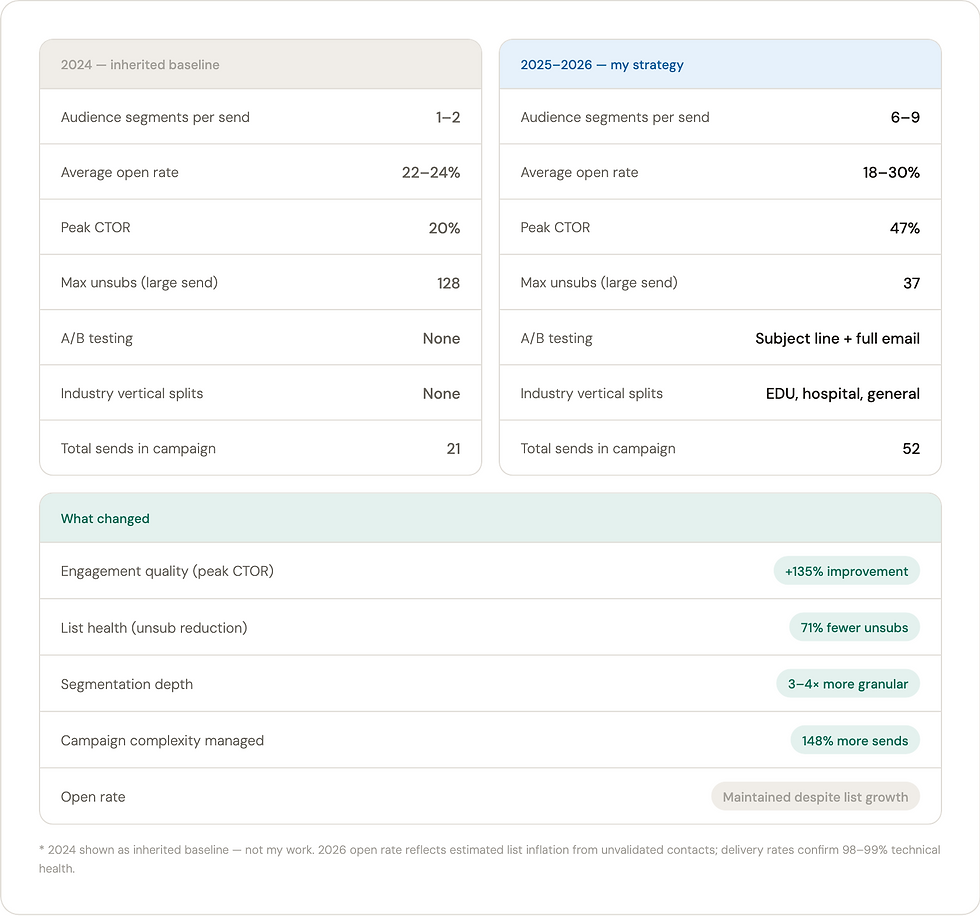
Early campaigns used a single undifferentiated list. By 2026, every send maps to a distinct sub-audience — six or more concurrent segments running at each touchpoint. Relevant messaging replaced volume as the primary lever.

Unsubscribes fell as relevance rose
Late-funnel 2024 sends (inherited baseline) saw spikes of 83–128 unsubs. By 2026, even sends to 50,000+ recipients generated fewer than 40 unsubs — a direct signal that messaging resonated rather than fatigued.

A/B testing embedded into workflow
2025 introduced systematic subject line and full-email A/B tests across multiple sends. The EM12 AP A/B test achieved 24% CTOR on a 40K list — a meaningful lift over untested sends in the same cycle.

Engagement depth, not just opens
The 2025 AR audience hit 47% CTOR on EM3 — nearly half of everyone who opened clicked through. This level of post-open engagement signals content tightly matched to audience intent.
Analytical Skills & Methodologies

Campaign Performance Analysis
Track and evaluate email performance across key metrics including open rate, click-to-open rate (CTOR), and unsubscribe trends to identify patterns and inform ongoing campaign strategy.

A/B Testing & Iteration
Design and execute A/B tests across subject lines and full email content, using results to continuously optimize messaging and improve engagement over time.

Audience Segmentation Strategy
Develop and refine audience segments based on behavior, industry, and engagement data to deliver more relevant messaging and improve overall campaign performance.

Engagement-Focused Optimization
Prioritize deeper engagement metrics—such as CTOR and post-open behavior—over surface-level opens to better understand content effectiveness and audience intent.